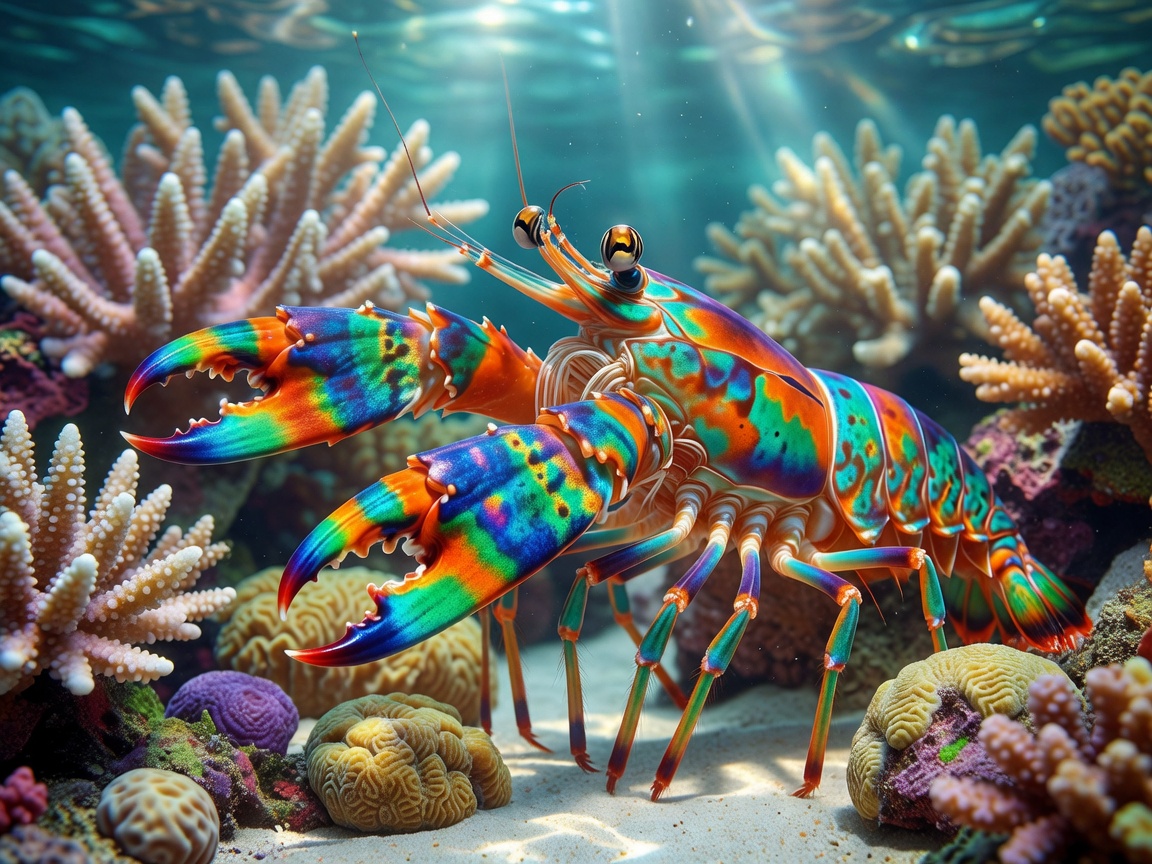
The peacock mantis shrimp (Odontodactylus scyllarus) possesses what is pound-for-pound the most lethal, high-acceleration blunt-force weapon anywhere in the animal kingdom. While measuring merely 10 to 18 centimeters in length, this benthic crustacean routinely fractures reinforced aquarium glass, disintegrates thick gastropod shells, and generates localized water vapor explosions known as supercavitation.
The Biomechanical Spring: Saddle & Linkage Architecture
Muscular tissue alone cannot contract fast enough to achieve the 23 meters-per-second (83 km/h) velocity measured in mantis shrimp strikes. To circumvent biochemical limits, the stomatopod evolved a four-bar biological linkage system composed of:
- Hyperbolic Saddle Sclerite: A saddle-shaped spring composed of mineralized chitin and amorphous calcium carbonate that stores elastic potential energy under compression.
- Cuticular Latch Mechanism: Mineralized apodemes that lock the flexed raptorial appendage into position while the massive thoracic extensor muscles continuously charge the spring.
- Torque Trigger Release: When targeted prey moves within striking distance (3-5 cm), the locking apodemes release in less than 2 milliseconds, transferring stored energy into explosive kinetic motion.
⚡ Hydrodynamic Cavitation: The Secondary Shockwave
Because the dactyl club accelerates at over 10,000G through dense seawater, the water pressure immediately trailing the appendage drops below the vapor pressure of water. This creates an ephemeral vapor bubble. When this cavitation bubble collapses microseconds later, it produces a secondary shockwave that delivers an additional 1,500 Newtons of force, emits a brief flash of light (sonoluminescence), and temporarily heats localized molecules to over 4,700°C.
Empirical Ballistic Metrics
| Kinematic Parameter | Mantis Shrimp Metric | Human Comparative Reference |
|---|---|---|
| Appendage Acceleration | 102,000 m/s² (10,400 G) | 0.22 Caliber Bullet (~10,000 G) |
| Peak Strike Velocity | 23.0 m/s (82.8 km/h) | Professional Boxer Punch (~11 m/s) |
| Impact Force Peak | 1,501 N (337 lbf) | 2,500x the shrimp's own body weight |
| Cavitation Collapse Temp | ~4,700 Kelvin | Approaching surface of the Sun (5,778 K) |
Hyper-Spectral Hexanocular Vision
Beyond its lethal appendages, the mantis shrimp houses arguably the most sophisticated optical sensory array known. While humans rely on three color photoreceptor channels (RGB), stomatopods possess 12 to 16 distinct photoreceptor types capable of analyzing deep ultraviolet, circular polarized light, and linear polarized signals across independent mobile ocular stalks.
External Academic Documentation
Review peer-reviewed biomechanical publications on stomatopod dactyl club mineralization and nanostructure impact resistance hosted at the National Center for Biotechnology Information.
Access NCBI Stomatopod Research Dossier →