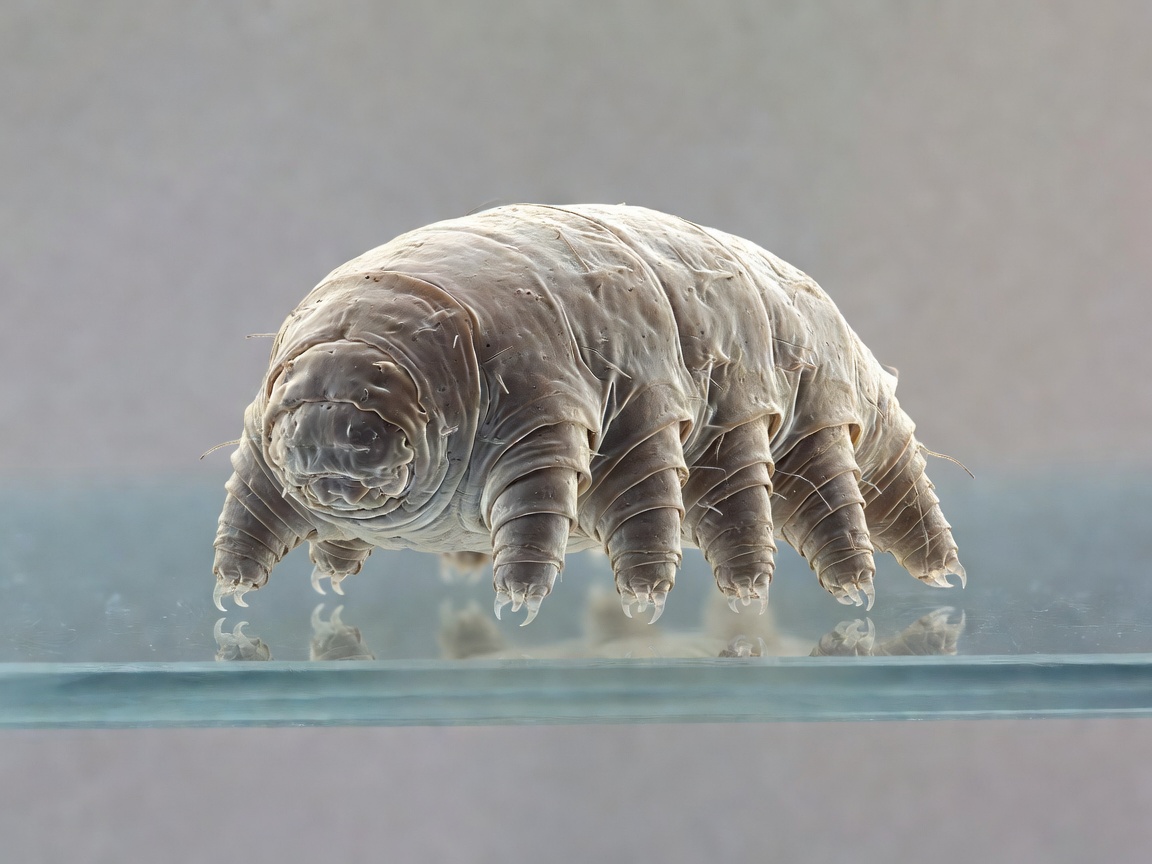
Tardigrades (commonly known as water bears or moss piglets) are microscopic eight-legged invertebrates that represent Earth's most resilient extremophiles. Capable of enduring conditions that sterilize all other known animal life, tardigrades survive temperatures as low as 1 Kelvin (-272°C), heating up to 150°C, hydrostatic pressure six times higher than the bottom of the Mariana Trench, and the raw ionizing vacuum of space.
The Anhydrobiotic 'Tun' State
Under desiccation, the tardigrade expels 97% of its somatic water content, contracts its eight legs inward, and curls into a shrunken barrel known as a tun. Metabolic activity decelerates by 99.99%, entering a state of cryptobiosis indistinguishable from biological death.
🛡️ TDPs and Dsup: Molecular DNA Body Armor
Instead of relying purely on trehalose sugars like brine shrimp, tardigrades synthesize unique Tardigrade-specific Intrinsically Disordered Proteins (TDPs). During dehydration, these unstructured proteins solidify into an intracellular bioglass matrix that immobilizes fragile macromolecules. Simultaneously, a unique chromatin-binding protein called Dsup (Damage Suppressor) binds physically to nuclear DNA, absorbing hydroxyl free radicals and preventing double-strand chromosome breaks during massive gamma irradiation.
Space Exposure: The FOTON-M3 Mission
In 2007, active and desiccated tardigrade specimens were placed on the exterior hull of the European Space Agency's FOTON-M3 orbital satellite. Exposed directly to open space vacuum, solar UV radiation (UV-A and UV-B), and cosmic rays for 10 consecutive days, over 68% of specimens successfully rehydrated and produced viable offspring upon returning to Earth.
Nature Communications Research Paper
Review the definitive genome sequencing of extremotolerant tardigrades and the discovery of the Dsup radioprotective protein on Nature Communications.
Access Nature Dsup Study →